



Executive Summary
Nuclear power is regaining importance in the global energy conversation as nations confront the dual challenges of limiting emissions while meeting soaring electricity demand. For years, nuclear power was overshadowed by the rapid rise of renewables and cheap natural gas. But today, the realities of climate policy, energy security, and the scale of power required for modern economies—especially with the growth of AI-driven data centers and electrification—are bringing nuclear back to the forefront. Its ability to provide massive amounts of carbon-free, always-available electricity makes it uniquely positioned among clean energy sources. At the same time, advances in reactor technology, growing political support, and renewed investment are reshaping the industry’s outlook. What was once seen as a legacy technology is now increasingly viewed as an indispensable pillar of the energy supply mix going forward. In 2025, there are currently 440 nuclear reactors worldwide. By 2030, this number is expected to reach 500, with an additional 400 reactors in various stages of development.
The History of Nuclear Power
Nuclear power has been part of the global energy mix since the 1950s, when the first U.S. reactor came online. Despite its reputation as one of the cleanest and most reliable sources of electricity, public sentiment toward nuclear power has fluctuated sharply.
- Early Days: In its first phase, nuclear development was accelerating, with roughly 10 new reactors commissioned for every one that was retired, underscoring its growing role in the grid.
- Contractions: However, the accidents at Chernobyl in 1986 and Fukushima in 2011 significantly slowed momentum. Following Chernobyl, new builds averaged only about six per year against four annual shutdowns, a pace that persisted into the early 2010s. After Fukushima, global perception of nuclear safety and reliability deteriorated further, and new plant additions barely kept pace with retirements. This prolonged stagnation resulted in decades of underinvestment across the nuclear value chain, as growth in the sector was constrained by lingering skepticism.
- Recent years: At its height in the 1980s (prior to the Chernobyl accident) nuclear energy accounted for roughly 17% of global electricity generation. By 2010, that share had declined to about 10%, and following Fukushima it slipped further to approximately 9%—a level that has largely persisted to the present day. In contrast, the U.S. nuclear fleet has proven more resilient. In 2025, nuclear still contributes around 18% of U.S. electricity generation, essentially unchanged from its share three decades ago. Despite this period marked by a largely stagnant industry, excitement for nuclear energy has re-emerged.
Why Nuclear is Poised to Have Its Moment Now
- Unmatched Reliability: Nuclear power consistently delivers the highest capacity factor of any energy source (above 90%), providing dependable, around-the-clock carbon-free generation.
- Essential to Cutting Emissions: As the only scalable, zero-emissions baseload solution, nuclear complements variable renewables and is indispensable to achieving net-zero targets.
- Rising Demand for Power: Structural shifts such as the growth of AI data centers, electric vehicles, and broader electrification are driving electricity demand well above historic levels, with forecasts calling for ~2.5% annual growth through 2030.
- Supportive Policy and Public Sentiment: After decades of hesitation, momentum is turning. U.S. public support has climbed to 61% (up from 44% in 2016), while 31 nations and leading global corporations have pledged to triple nuclear capacity by 2050.
Source: International Atomic Energy Agency (IAEA)
What’s Included in the Value Chain for the Nuclear Industry
Nuclear Value Chain
The nuclear industry encompasses the full value chain of uranium mining, fuel processing, reactor design and operation, and waste management, with nuclear power providing about 10% of global electricity. We group the industry into three broad categories.

Overview of In-Situ Recovery (ISR) Operations

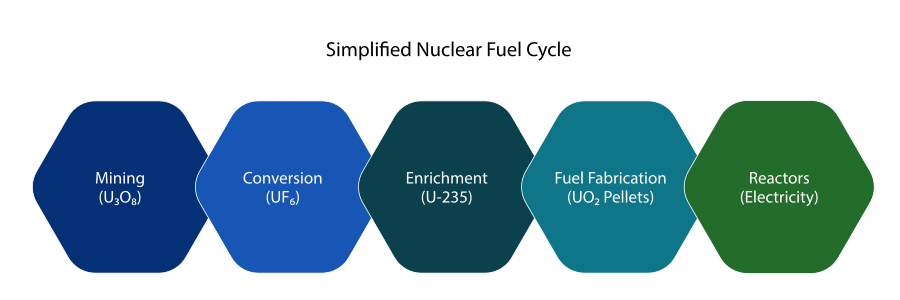
Uranium Mining & Milling: This sector covers the entire upstream fuel-supply chain from digging uranium ore out of the ground to delivering finished reactor fuel assemblies. It includes:
- Mining the ore and milling it into “yellowcake” concentrate
- Converting yellowcake into uranium hexafluoride gas
- Enriching that gas to boost its U-235 content to reactor-ready levels
- Pressing the enriched uranium into ceramic pellets, loading them into metal tubes, and bundling them into fuel rods.
Overview of Boiling Water Reactor
Reactor Design & Construction:
This group includes engineers, designers, and builders who bring a powerplant from a blueprint to reality. It covers those who:
- Develop reactor technologies and intellectual property
- Manufacture large-scale components (like pressure vessels and steam generators)
- Firms that manage the end-to-end project delivery, including engineering, procurement of specialist equipment, and on-site construction.
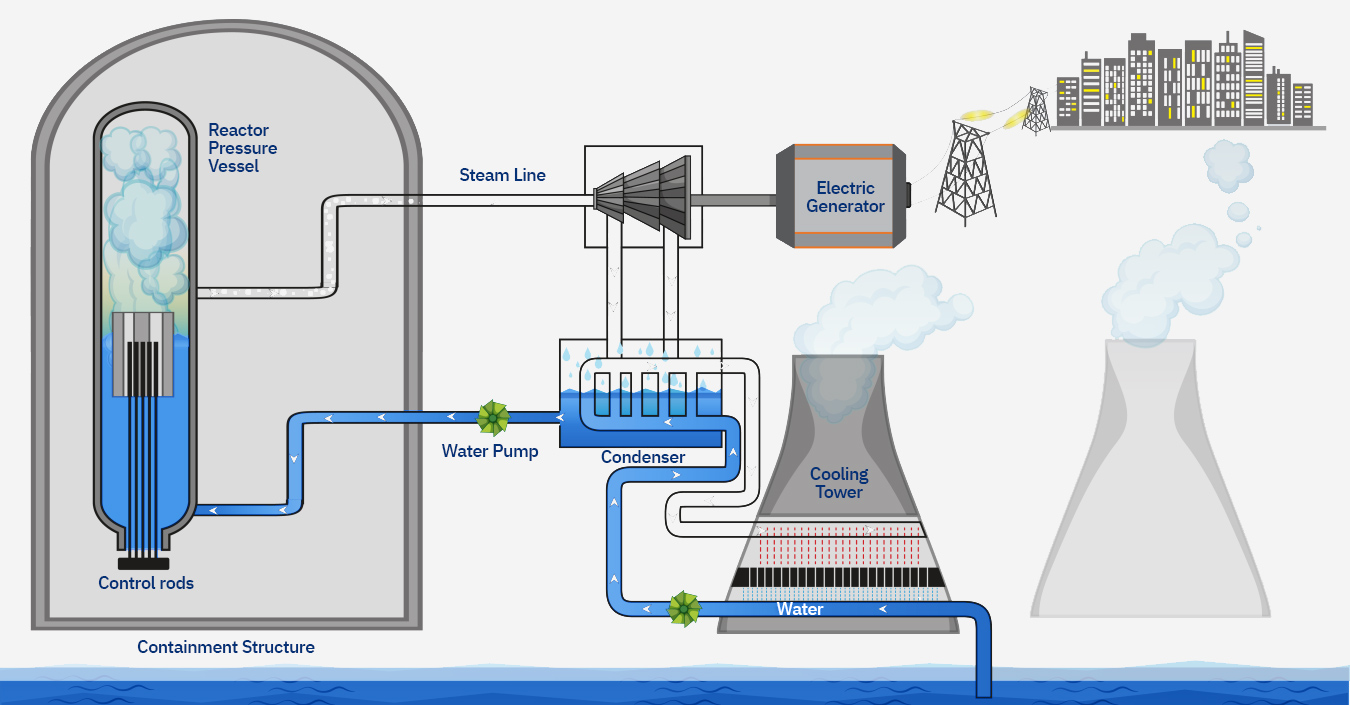
Operation & Maintenance: Once a nuclear plant is built, this sector keeps it safe and operating efficiently for decades. It includes:
- The utilities or general operations that own and operate reactors day-to-day
- The service companies that supply spare parts, handle refueling outages, perform inspections, and carry out upgrades and long-term maintenance.

Risk Factors of the Nuclear Industry
- Regulatory Risk: Nuclear power is one of the most highly regulated industries in the world, with oversight spanning federal, state, and international authorities. Operators must comply with stringent safety, security, and environmental standards, often requiring multi-year review and licensing processes. Any changes in regulatory frameworks—such as new safety requirements, delays in license extensions, or modifications to production tax credit eligibility—can significantly alter project economics. The complexity of compliance also increases the risk of delays, cost escalations, or even cancellations if approvals are not granted on time.
- Public Opposition: Despite growing recognition of nuclear energy’s role in dependable carbon-free energy, public acceptance remains uneven. Communities near proposed sites frequently raise concerns over safety, waste management, and environmental impacts, leading to organized opposition or “Not In My Backyard” campaigns. In some cases, political pressure from public sentiment has led to premature plant shutdowns, as seen in Germany and in parts of the U.S. Sustained opposition can delay permitting, increase legal costs, and ultimately threaten the viability of new nuclear developments.
- Supply Chain Risk: Nuclear projects rely on highly specialized equipment and materials, many of which are produced by a limited number of global suppliers. Reactor pressure vessels, steam generators, and enriched uranium fuel have few qualified manufacturers, creating bottlenecks and pricing pressure. Geopolitical factors further heighten risks, as uranium enrichment capacity is concentrated in Russia and allied nations. Disruptions in the availability of components, raw materials, or skilled nuclear engineers can delay construction, inflate budgets, and compromise project delivery timelines.
- Project Delays and Cost Overruns: Historically, nuclear construction projects have faced chronic schedule slippages and budget overruns. The complexity of plant design, combined with evolving safety requirements and labor shortages, increases the likelihood of execution risk. Recent examples—such as the Vogtle expansion in Georgia—illustrate how multi-billion-dollar overruns can strain utility balance sheets, reduce investor confidence, and trigger regulatory scrutiny. These risks are magnified for newer technologies like small modular reactors (SMRs), where unproven designs and limited deployment experience may further challenge cost predictability.
Global Nuclear Power Capacity
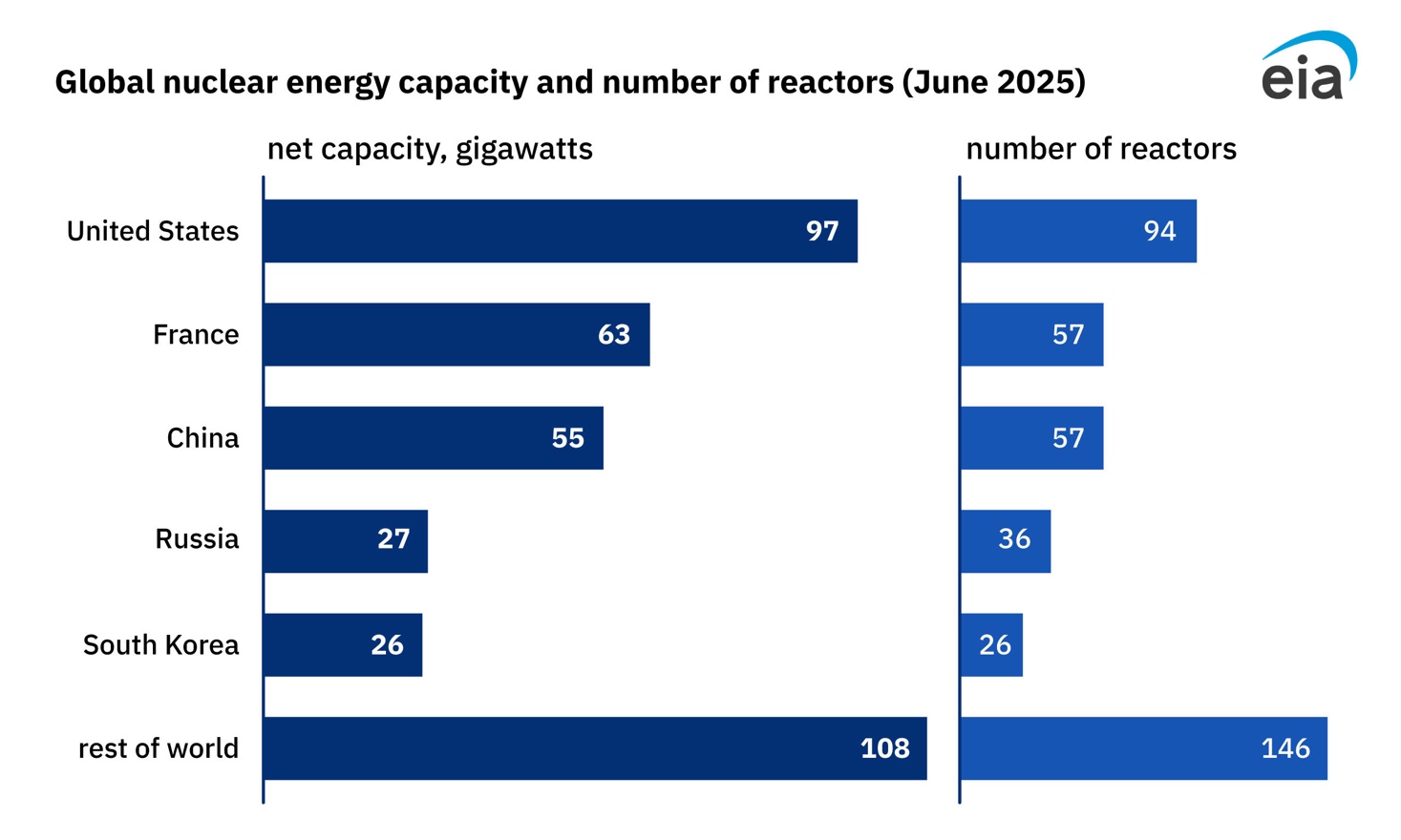
Five countries account for more than two-thirds of global nuclear electricity generation capacity, led by the United States, France, China, Russia, and South Korea, according to International Atomic Energy Agency (IAEA) data as of June 2025. Worldwide, 416 reactors are operating across 31 countries, with a total installed net generating capacity of 376 gigawatts (GW).
- United States: Commercial nuclear power began in the late 1950s with the Shippingport Atomic Power Station in Pennsylvania. Most of today’s U.S. capacity was built between 1967 and 1990. The U.S. now operates 94 reactors, the largest fleet globally, and remains the world’s top producer of nuclear electricity. In 2024, nuclear accounted for 782 GWh, or 19% of U.S. generation, representing nearly 30% of the global total. The fleet continues to perform at a tier 1 capacity factor of 92%, reflecting improved efficiency in managing outages.
- France: France operates the second-largest reactor fleet worldwide, with 57 units totaling 63 GW of capacity. Nuclear generated more than 320 GWh in 2023, supplying nearly 65% of France’s electricity. The buildout was largely concentrated between 1975 and 1990, when 52 reactors were commissioned in response to the global oil crisis, cementing nuclear as the backbone of French energy security.
- China: China has emerged as the fastest-growing nuclear market, with 57 reactors commissioned since 1991 and 28 more under construction (30 GW combined). Once completed, China’s total capacity will surpass that of France. In 2023, nuclear power produced over 433 GWh, or 5% of China’s electricity generation. China has leveraged international partnerships with France, Canada, and Russia, and has localized designs such as Westinghouse’s AP1000 into its CAP1000 model.
- Russia: Russia operates 36 reactors with 27 GW of capacity, with 4 additional units (4 GW) under construction. Rosatom, the state-owned nuclear conglomerate, is modernizing its fleet by replacing older RBMK designs with larger, more efficient VVER-1000 and VVER-1200 units. Beyond domestic operations, Rosatom has become the world’s largest exporter of nuclear technology.
- South Korea: Driven by energy security priorities, South Korea began its nuclear program in the 1970s. Today, it operates 26 reactors with 2 more under construction. Korea Hydro & Nuclear Power (KHNP), the state-backed operator, is a growing international vendor. KHNP built the UAE’s Barakah plant and has been selected to supply reactors for the Dukovany expansion in the Czech Republic.
Uranium Mining and Global Supply
Uranium, the essential fuel for nuclear power, is geologically widespread but commercially mined in only a handful of countries. According to the International Atomic Energy Agency’s World Distribution of Uranium Deposits (UDEPO) database and the joint IAEA/Organisation for Economic Co-operation and Development (OECD) “Red Book,” five countries dominate global supply, collectively accounting for more than three-quarters of annual mine production.
- Kazakhstan has been the world’s largest producer for over a decade, contributing roughly 40-45% of global supply. The country’s in-situ recovery (ISR) mines are among the lowest-cost producers worldwide, making Kazakhstan the backbone of today’s uranium market.
- Canada, with its Athabasca Basin deposits, is home to some of the richest ore grades globally and typically accounts for ~15% of production.
- Namibia has emerged as a key supplier, producing ~10-12% of global output, anchored by large-scale open-pit mines operated by multinational companies.
- Australia possesses the world’s largest identified uranium resources, though current production is modest compared to its reserve base due to regulatory and political constraints.
- Russia maintains a steady domestic production profile of ~5% and is also the world’s most significant exporter of nuclear technology through Rosatom.
- Other contributors include Uzbekistan, Niger, China, and the United States, but each represents a small fraction of total global output.
As mentioned, despite the broad geographic distribution of uranium deposits, actual mining is concentrated in relatively few jurisdictions with favorable geology, regulatory stability, and established infrastructure. This concentration creates supply chain vulnerabilities, particularly considering geopolitical risk. For example, over 60% of primary uranium supply originates from just two countries—Kazakhstan and Canada—making the market highly sensitive to disruptions.
From a long-term perspective, the International Atomic Energy Agency (IAEA) estimates that identified recoverable resources are sufficient to support demand for many decades at current consumption rates. However, years of underinvestment, combined with rising reactor demand and the multi-year lead times required to restart or develop new mines, suggest the market could tighten significantly if demand accelerates.

To that point, growing interest in nuclear as a reliable, low-carbon source of baseload power—combined with the expected deployment of small modular reactors (SMRs)—is set to drive uranium consumption higher. Current forecasts suggest that without meaningful additions to supply, the market could face a structural shortfall by the late 2030s, underscoring the importance of advancing new projects and expanding exploration activity over the next decade.
Fuel Conversion and Enrichment
Conversion: Once uranium ore (U₃O₈, or “yellowcake”) is mined, it must be converted into uranium hexafluoride (UF₆), the chemical form suitable for enrichment. Conversion is a critical step because fluorine has only one naturally occurring isotope, making isotope separation during enrichment more efficient.
According to the World Nuclear Association, there is ~62,000 tonnes of licensed uranium conversion capacity worldwide, though actual production is closer to 42,000 tonnes. More than half of this output is concentrated in Russia and China, highlighting the sector’s geographic concentration. This limited and concentrated production makes conversion the primary bottleneck in the nuclear fuel cycle today.
Enrichment: Following conversion, UF₆ undergoes enrichment to increase the proportion of fissile U-235 from its natural level of ~0.7% to the 3-5% range typically required for light-water reactors.
Enrichment capacity is categorized by regulation:
- Up to 10% U-235 enrichment can be achieved in Category III facilities.
- 10–20% requires Category II licenses and higher capital investment.
- >20% enrichment is restricted to Category I facilities due to proliferation risk.
Proliferation risk refers to the danger that civilian nuclear technology, materials, or expertise could be diverted for the development of nuclear weapons or other non-peaceful purposes. The central concern lies in the enrichment and reprocessing stages of the nuclear fuel cycle, since both involve materials that can, under certain conditions, be repurposed into weapons-grade fuel.
The industry’s performance is measured in Separative Work Units (SWU), representing the effort required to separate uranium isotopes. Roughly 8-9 SWU are needed to enrich 1 kg of uranium to 5% U-235, depending on the tails assay (the residual U-235 content in depleted uranium).
Global enrichment capacity is estimated at ~62 million SWU annually, equivalent to producing 7,000 tonnes of enriched uranium product from ~65,000 tonnes of U₃O₈ feed. Unlike conversion, enrichment is not currently a bottleneck, as facilities can “overload” to deliver incremental capacity when demand requires.
Recent Trends
Nuclear power is increasingly recognized as a critical solution to today’s growing demand for reliable sources of electricity. After nearly half a decade of flat spending, global investment in nuclear generation grew at a ~14% compound annual growth rate (CAGR) between 2020 and 2024, reflecting the urgency of adding reliable baseload capacity. With most plants producing 1 GW or more and operating continuously as long as fuel is available, nuclear offers a scale and reliability unmatched by other carbon-free sources.
The challenge lies in timing. Years of underinvestment have constrained the supply chain, and new reactors require six to twelve years on average to complete—often longer in markets without an established nuclear ecosystem. As a result, life extensions for existing reactors have become the most practical near-term bridge. With the global fleet averaging 32 years of age, and U.S. plants generally licensed for 40 years, many units are approaching renewal decisions.
We expect a significant share of reactors to pursue extensions, helping preserve critical capacity until new builds come online. This sector evolves slowly, so any major changes will take years. If demand for data center power rises and nuclear continues to have regulatory backing, the industry will adjust.
Conclusion
Nuclear power is entering a period of renewed relevance. After decades of underinvestment and wavering public sentiment, the industry now stands at the intersection of rising electricity demand, a need for reliable baseload generation, and supportive policy frameworks. While challenges remain—particularly in supply chain capacity, regulatory complexity, and project execution—the fundamentals point to a durable resurgence.
Uranium supply constraints, conversion bottlenecks, and the long lead times for new reactors highlight both risks and opportunities for investors. At the same time, reactor life extensions, the emergence of small modular reactors, and global commitments to expand capacity create a foundation for long-term growth.
For investors, the proposal is clear: nuclear energy is no longer a legacy technology but a strategic asset in the global power mix. Exposure to the nuclear value chain—from mining through fuel processing and reactor operations—offers a unique opportunity to participate in one of the most compelling structural growth stories in global infrastructure today.
The nuclear renaissance is here and is reshaping the energy landscape.
The Tortoise Nuclear Renaissance (TNUK) targets the full nuclear value chain
fueling this resurgence.
Important Information
Nothing contained in this communication constitutes tax, legal, or investment advice. Investors must consult their tax advisor or legal counsel for advice and information concerning their particular situation. This communication contains certain statements that may include “forward-looking statements.” All statements, other than statements of historical fact, included herein are “forward-looking statements.” Although Tortoise Capital believes that the expectations reflected in these forward-looking statements are reasonable, they do involve assumptions, risks and uncertainties, and these expectations may prove to be incorrect. Actual events could differ materially from those anticipated in these forward-looking statements as a result of a variety of factors. You should not place undue reliance on these forward-looking statements. This communication reflects our views and opinions as of the date herein, which are subject to change at any time based on market and other conditions. We disclaim any responsibility to update these views. These views should not be relied on as investment advice or an indication of trading intention. Discussion or analysis of any specific company-related news or investment sectors are meant primarily as a result of recent newsworthy events surrounding those companies or by way of providing updates on certain sectors of the market. Tortoise Capital, through its family of registered investment advisers, does provide investment advice to Tortoise-related funds and others that include investment into those sectors or companies discussed in this communication. As a result, Tortoise Capital does stand to beneficially profit from any rise in value of the sectors broadly discussed, including individual companies contained within.
Tortoise Capital Advisors, LLC is the advisor to the Tortoise Nuclear Renaissance ETF.
Before investing in the funds, investors should consider their investment goals, time horizons and risk tolerance. The funds’ investment objective, risks, charges and expenses must be considered carefully before investing. The statutory prospectuses and the summary prospectuses (click here) contain this and other important information about the funds. Copies of the funds’ prospectus may be obtained by calling 855-994-4437 or by emailing info@tortoisecapital.com. Read it carefully before investing.
As stated in the Prospectus, the total annual operating expenses are 0.75%. The adviser has agreed to pay all expenses incurred by the fund except for the advisory fee, interest, taxes, brokerage expenses and other fees, charges, taxes, levies or expenses (such as stamp taxes) incurred in connection with the execution of portfolio transactions or in connection with creation and redemption transactions.
Investing involves risk. Principal loss is possible. The Fund is classified as “non-diversified,” which means the Fund may invest a larger percentage of its assets in the securities of a smaller number of issuers than a diversified fund. Investments in securities of a limited number of issuers exposes the Fund to greater market risk and potential losses than if its assets were diversified among the securities of a greater number of issuers. The Fund will be sensitive to, and its performance will depend to a greater extent on, the overall condition of companies in the Nuclear Industries. Companies in the Nuclear Industries may face considerable risk as a result of, among other risks, incidents and accidents, breaches of security, ill-intentioned acts of terrorism, air crashes, natural disasters (such as floods or earthquakes), equipment malfunctions or mishandling in storage, handling, transportation, treatment or conditioning of substances and nuclear materials.
Derivatives include instruments and contracts that are based on and valued in relation to one or more underlying securities, financial benchmarks, indices, or other reference obligations or measures of value. Investments in securities of foreign companies involve risks not ordinarily associated with investments in securities and instruments of U.S. issuers, including risks relating to political, social and economic developments abroad, differences between U.S. and foreign regulatory and accounting requirements, tax risks, and market practices, as well as fluctuations in foreign currencies. Companies defined as small and mid-cap securities may involve greater risk than is normally associated with large cap companies, and as a result may be more volatile and less liquid than the securities of large-cap companies, and may have returns that vary substantially from the overall securities markets.
Shares of exchange-traded funds (ETFs) are not individually redeemable and owners of the shares may acquire those shares from the ETF and tender those shares for redemption to the ETF in Creation Units only, see the ETF prospectus for additional information regarding Creation Units. Investors may purchase or sell ETF shares throughout the day through any brokerage account, which will result in typical brokerage commissions.
Nothing on this website should be considered a solicitation to buy or an offer to sell any shares of the portfolio in any jurisdiction where the offer or solicitation would be unlawful under the securities laws of such jurisdiction. Nothing contained in this communication constitutes tax, legal or investment advice. Investors must consult their tax advisor or legal counsel for advice and information concerning their particular situation.
Quasar Distributors, LLC, distributor
NOT FDIC INSURED · NO BANK GUARANTEE · MAY LOSE VALUE