



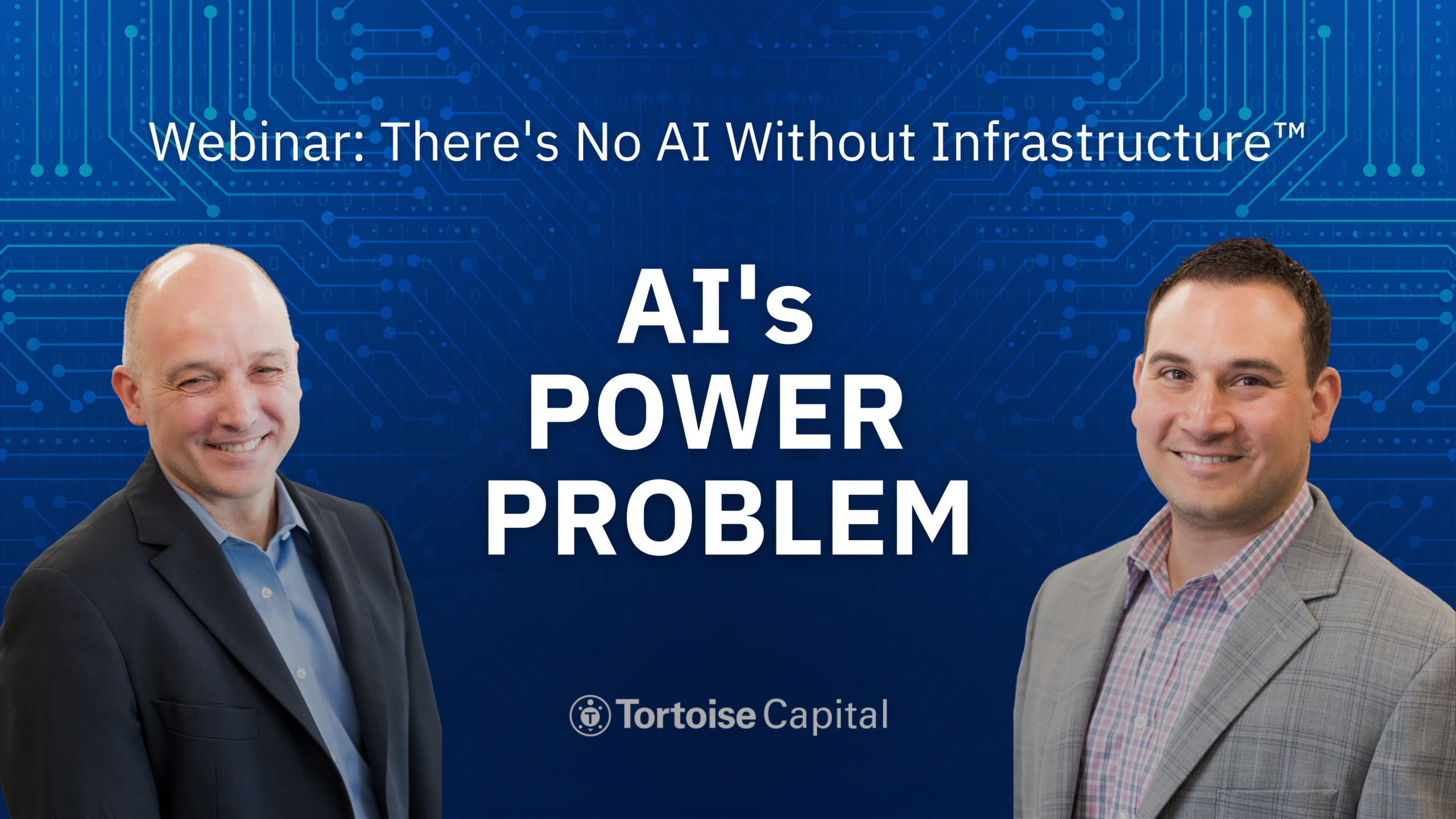
AI doesn’t run on code alone—it runs on infrastructure. As artificial intelligence accelerates, demand for electricity, data centers, and digital infrastructure is creating new investment opportunities across the energy and technology landscape.
In this webinar replay, Rob Thummel, Senior Portfolio Manager, and Mark Marifian, Head of Product, explore why “Electricity Is the New Oil,” the infrastructure needed to support AI’s rapid expansion, and how the Tortoise AI Infrastructure ETF (TCAI) seeks to capitalize on these long-term trends. They also discuss the potential impact of the 2026 midterm elections, the expanding universe of AI-focused ETFs, and what differentiates TCAI’s actively managed approach.
Key Takeaways:
- Why “Electricity Is the New Oil” as AI drives unprecedented power demand
- The critical role of natural gas, data centers, and digital infrastructure in supporting AI growth
- How supply and demand imbalances are creating opportunities across AI infrastructure
- What differentiates TCAI from other AI-focused ETFs and how its portfolio is positioned
- Why Tortoise believes the long-term AI infrastructure outlook remains intact despite market volatility and political uncertainty
Important Information
Nothing contained in this communication constitutes tax, legal, or investment advice. Investors must consult their tax advisor or legal counsel for advice and information concerning their particular situation. This podcast contains certain statements that may include “forward-looking statements.” All statements, other than statements of historical fact, included herein are “forward-looking statements.” Although we believe that the expectations reflected in these forward-looking statements are reasonable, they do involve assumptions, risks and uncertainties, and these expectations may prove to be incorrect. Actual events could differ materially from those anticipated in these forward-looking statements as a result of a variety of factors. You should not place undue reliance on these forward-looking statements. This podcast reflects our views and opinions as of the date herein, which are subject to change at any time based on market and other conditions. We disclaim any responsibility to update these views. These views should not be relied on as investment advice or an indication of trading intention. Discussion or analysis of any specific company-related news or investment sectors are meant primarily as a result of recent newsworthy events surrounding those companies or by way of providing updates on certain sectors of the market. Through our family of registered investment advisers, we provide investment advice to related funds and others that includes investment into those sectors or companies discussed in these podcasts. As a result, we stand to beneficially profit from any rise in value from many of the companies mentioned herein including companies within the investment sectors broadly discussed.
This presentation is for informational and educational purposes only. This should not be re-published or re-produced without the written consent of Tortoise Capital Advisors, LLC. This material should not be construed as an offer to buy, sell, or otherwise transact in any security or advisory service.
Tortoise Capital Advisors, LLC. (TCA) is the adviser to the Tortoise Capital AI Infrastructure ETF.
The funds’ investment objective, risks, charges and expenses must be considered carefully before investing. The statutory prospectuses and the summary prospectuses (click here) contain this and other important information about the funds. Copies of the funds’ prospectus may be obtained by calling 855-994-4437 or by emailing info@tortoisecapital.com. Read it carefully before investing.
The performance data quoted represents past performance. Past performance is no guarantee of future results. Current performance may be lower or higher than the performance data quoted. Investment return and principal value will fluctuate so that an investor’s shares, when redeemed, may be worth more or less than original cost. Returns less than one year are not annualized. NAV prices are used to calculate market price performance prior to the date when the fund first traded on the New York Stock Exchange. Market performance is determined using the bid/ask midpoint at 4:00pm Eastern time, when the NAV is typically calculated. Market performance does not represent the returns you would receive if you traded shares at other times. For the fund’s most recent month end performance, please call (855) 994-4437.
As stated in the Prospectus, the total annual operating expenses are 0.65%. The adviser has agreed to pay all expenses incurred by the fund except for the advisory fee, interest, taxes, brokerage expenses and other fees, charges, taxes, levies or expenses (such as stamp taxes) incurred in connection with the execution of portfolio transactions or in connection with creation and redemption transactions.
Investing involves risk. Principal loss is possible. Because the fund is “non-diversified” and may invest a greater percentage of its assets in the securities of a single issuer, a decline in the value of an investment in a single issuer could cause the fund’s overall value to decline to a greater degree than if the fund held a more diversified portfolio. The fund’s strategy of emphasizing investments in AI infrastructure companies means that the performance of the fund will be closely tied to the performance of one or more industries that are expected to benefit from the growth of AI-capable data centers and related technology and energy infrastructure. Investing in companies that are expected to benefit from the same macro theme means that some of the fund’s investments may be similarly affected by certain market, economic, political, or social developments. Companies in the energy infrastructure sector are subject to many risks that can negatively impact the revenues and viability of companies in this sector, including, but not limited to risks associated with companies owning and/or operating pipelines, gathering and processing assets, power infrastructure, propane assets, as well as capital markets, terrorism, natural disasters, climate change, operating, regulatory, environmental, supply and demand, and price volatility risks. Companies in the technology infrastructure sector are subject to many risks that can negatively impact the revenues and viability of companies in this sector, including, but not limited to risks associated with emerging technology that renders existing products or services obsolete, reliance on outdated technology, intellectual property theft, supply chain disruption, vulnerabilities to third-party vendors and suppliers, business interruption, difficulty in retaining skilled talent, and regulatory compliance. Companies in the industrial sector face a variety of risks, including commodity price volatility, supply chain disruptions, potential obsolescence of technologies, economic downturns, and increasing competition.
Investment advisers, including the Adviser, must rely in part on digital and network technologies (collectively “cyber networks”) to conduct their businesses. Derivatives include instruments and contracts that are based on and valued in relation to one or more underlying securities, financial benchmarks, indices, or other reference obligations or measures of value. If the fund writes a covered call option, during the option’s life the fund gives up the opportunity to profit from increases in the market value of the security covering the call option above the sum of the premium and the strike price of the call, but retains the risk of loss should the price of the underlying security decline. Investments in securities of foreign companies involve risks not ordinarily associated with investments in securities and instruments of U.S. issuers, including risks relating to political, social and economic developments abroad, differences between U.S. and foreign regulatory and accounting requirements, tax risks, and market practices, as well as fluctuations in foreign currencies.
The fund may be exposed to liquidity risk when trading volume, lack of a market maker, or legal restrictions impair the fund’s ability to sell particular securities or close call option positions at an advantageous price or in a timely manner. Illiquid investments may include restricted securities that cannot be sold immediately because of statutory and contractual restrictions on resale. Mid-cap and small-cap companies may not have the management experience, financial resources, product or business diversification and competitive strengths of large cap companies.
Shares of exchange-traded funds (ETFs) are not individually redeemable and owners of the shares may acquire those shares from the ETF and tender those shares for redemption to the ETF in Creation Units only, see the ETF prospectus for additional information regarding Creation Units. Investors may purchase or sell ETF shares throughout the day through any brokerage account, which will result in typical brokerage commissions.
There is no guarantee the fund will pay distributions in the future and distributions, if any, may be less than the current distribution.
Quasar Distributors, LLC, distributor
- NOT FDIC INSURED • NO BANK GUARANTEE • MAY LOSE VALUE
Past performance is no guarantee of future results.